Millions of credits are traded every year under the Kyoto Protocol or on the voluntary market through Regional carbon credit trading systems across Europe and North America. Here, carbon credits can be bought from projects that have a positive impact on the environment such as regenerative farming or reforestation projects. The credits can then be held as an investment, used to offset carbon emissions or sold to other people who want to reduce their own emissions, either voluntarily or through government imposed compliance.
Through the Carbon credit system, funds are starting to flow from private capital into climate-action initiatives that would not have gotten off the ground otherwise. Whilst these initiatives are helping fund innovation in climate technology and supporting emission reduction projects on the ground, the current system is far from perfect. With the demand for carbon credits expected to grow rapidly, and indeed it must if we are to meet the Paris Agreement of limiting climate change to 1.5% by 2030, the carbon market must prepare for hyper growth.
The Problem with the market today
Today’s carbon credit market is ‘opaque, cumbersome and expensive’, with price variance across the different settings. This has given rise to carbon credits originating from projects that overstated their emissions reductions. Also, due to a lack of pricing data, buyers cannot determine if they are paying a fair price, and suppliers cannot take the risk of implementing carbon-reduction initiatives without knowing how much buyers will eventually pay for carbon credits. These are key challenges for market players that include standard-setting agencies, financial institutions, market infrastructure providers, and stakeholders. It is clear that the world requires a substantial, high-quality, verifiable, and ecologically robust carbon credit market if we are to scale at a meaningful rate.
It is therefore vital for carbon credit buyers to have a carbon credit platform that provides a supply of reliable, high-quality carbon credits.
Introducing Likvidi Carbon Credits
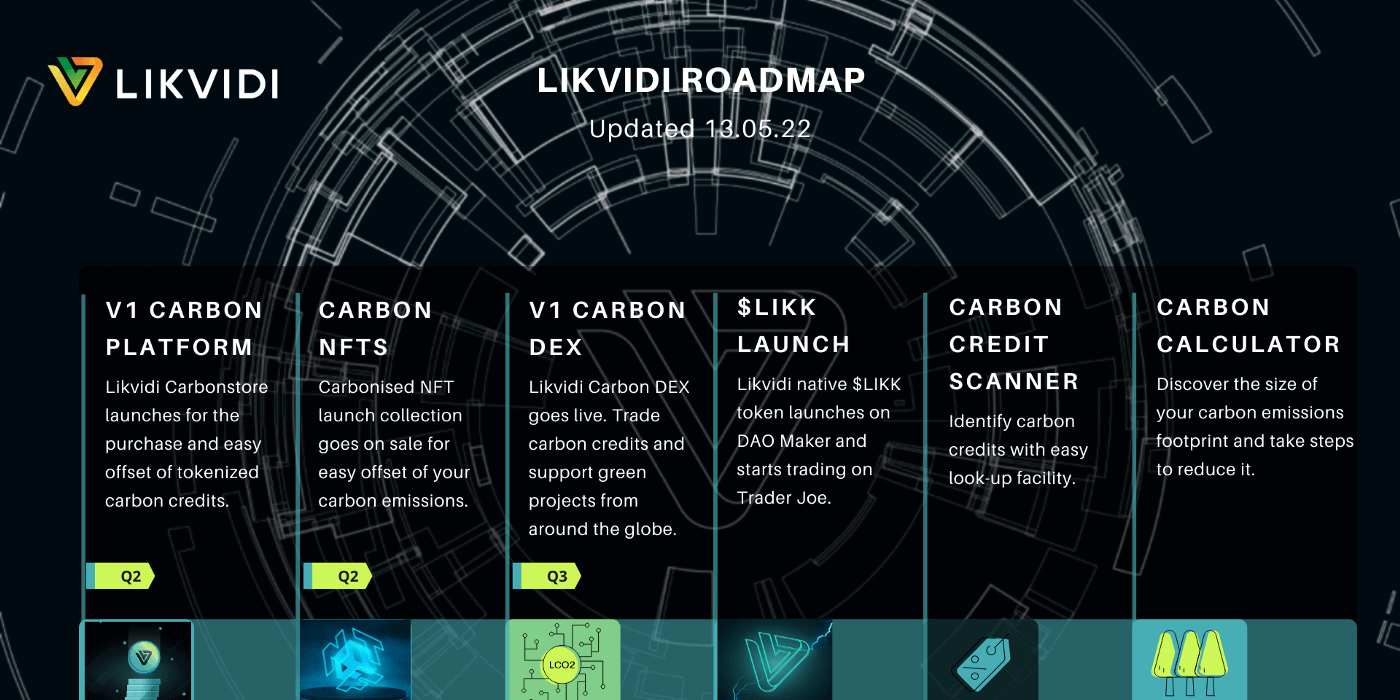
Likvidi’s Carbon Credits ‘LCO2’ are a tokenized solution for the carbon credits market that will print data into the credit for better transparency on its origin, quality, and lifespan. A sound crediting system is an integral part of good climate policy and Likvidi see the potential of blockchain to bring accountability to the global carbon crediting market. LCO2 credits will be tradable on exchanges and decentralized finance venues which will open up new markets for price discovery, starting with the Likvidi Carbon Credit Platform. The platform will complete the ecosystem authenticating the whole lifecycle of a carbon credit, from source to issuance, auditing, trading, and retirement or ‘offset’.
At Likvidi, we believe that the financial markets will play a significant role in getting us to net-zero. We select premium regenerative projects for the LCO2 carbon credit supply from the farming and forestry industries. The quality of the carbon credits will be possible to verify on the blockchain at carboncreditscanner.com before purchase. In addition, Likvidi’s carbon footprint calculator will help users to understand the size of their carbon usage with ease and know how much to offset per year. When an individual or a company buys LCO2 tokens from Likvidi, they can get up to 20% bonus credits by trading in Likvidi Tokens ($LIKK), the native token of the Likvidi ecosystem.
Just some of the many features of tokenized carbon credits:
- Certification of net-zero emissions: LCO2 can be used to offset your carbon footprint by retiring them (’burning’) to mitigate climate change.
- Easy lookup of credit origin: Anyone, at any time, can check the history and authenticity of each carbon credit without being a client or a member of a registry.
- Purchase Instantly: Users can buy and manage LCO2 instantly via the Likvidi Carbon Credit Platform.
- Tradeable: LCO2 are Web-3 integrated meaning you can freely move them about to trade on decentralized exchanges like the Likvidi Carbon DEX (more about this soon) as well as other prominent DeFi platforms.
- Audit trail: There is no better way to prove the provenance of carbon credit than an immutable audit record.
- Global market: Blockchain opens access to the wider global community to buy, sell and offset its carbon emissions, making saving the planet a whole lot easier.
Likvidi carbon credits [LCO2] and the Likvidi Carbon Credits Platform are launching this Summer!
Join the conversation: https://t.me/likvidiofficial.